Most girls begin puberty sometime between ages 8 and 13.
Yes, that range is huge.
And yes, that’s exactly why puberty feels confusing, unpredictable, and a little like a pop quiz no one studied for.
And it’s also exactly why parents find themselves thinking:
“Wait, are we early? Late? Is this normal? Should I be buying bras or still packing animal crackers?”
One girl starts developing in third grade. Another girl looks exactly the same until middle school. One needs deodorant, like … yesterday, while another still smells like sunshine and snacks. All of it?
All of it?
Completely normal.
Even for those of us who’ve been through puberty, going through this stage as a mom with our daughter can feel overwhelming!
Because we just want to do it better for our daughters.
The good news? Puberty doesn’t arrive all at once, and you’re not behind for feeling unsure.
This blog will walk you through:
- Early signs of puberty in girls
- What’s actually normal (even if it feels early)
- How to support your daughter without panic, pressure, or awkward overreactions.
Deep breath. You’re doing fine.
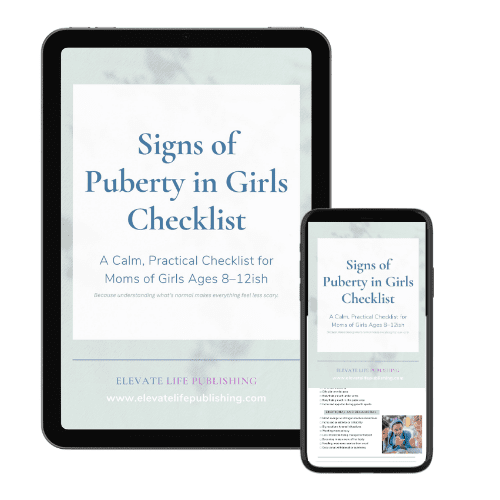
If you’re ready to get the free checklist that walks you through all the aspects of what changes you should be on the look out for, even some changes that aren’t really talked about. Download this free checklist.

Puberty Doesn’t Follow a Schedule (and That’s Normal)
Puberty isn’t a single moment. It’s more like a slow rollout of updates, and every body installs them on its own timeline.
Some girls get early access.
Some are fashionably late.
Some hover in the “downloading…” phase for years.
Puberty doesn’t run on a schedule. It runs on biology.
A few factors that influence when puberty starts:
- Genetics (your own timeline often matters more than you realize)
- Overall health
- Nutrition
- Environment
- Body composition
So when your daughter asks:
- “Why is this happening to me but not my friend?”
- “Am I early?”
- “Am I weird?”
The most honest (and comforting) answer is:
👉 Everyone’s body has its own calendar.
Now let’s clear up one of the biggest misunderstandings parents have (and the thing that causes a lot of unnecessary panic):
One Big Misunderstanding: Puberty does NOT start with a period.
This is where a lot of unnecessary panic comes from.
A period usually comes later, after the body has already been changing for quite a while.
Think of a period as the grand finale, not the opening act.
Before a first period ever shows up, girls often experience (which we’ll cover it more in-depth later):
- Breast budding (often the very first sign)
- Growth spurts that seem to happen overnight
- New body odor (hello deodorant aisle)
- Mood swings that feel intense—for everyone involved 😅
- Body hair in new places
- Emotional sensitivity that turns small issues into big feelings
And here’s the part no one warns you about:
These changes can start months or even years before a period ever appears.
So if you’re thinking:
- This feels early…
- Why didn’t this happen this way when I was growing up?
- Is this normal?
Welcome to the club!
Puberty is normal, unpredictable, and rarely neat. Understanding that alone removes a lot of fear.
For moms and daughters.
Because knowledge doesn’t make puberty awkward.
Silence does.
Early Signs of Puberty in Girls (What They Really Mean)
Puberty rarely announces itself with a formal memo. Instead, it shows up quietly, inconsistently, and sometimes all at once, leaving parents wondering, Is this puberty… or just a weird week?
Here are some of the most common early signs and what they actually mean.
Breast Development
Often the first visible sign of puberty, breast development can start as small, tender lumps under one or both nipples. This can feel surprising (and uncomfortable), especially if it appears on only one side at first.
Important reassurance:
- Uneven development is extremely common
- Complaints of tenderness come and go
- One side may lead the other for months (sometimes longer)
Nothing is wrong.
Nothing needs to be fixed.
This stage is awkward but temporary.
Growth Spurts
If pants suddenly look like capris and shoes seem to shrink overnight, a growth spurt may be underway.
Many girls experience:
- Rapid height changes
- Long limbs before the rest of the body catches up
- Temporary clumsiness (bumping into door frames totally counts)
This is your clue to expect wardrobe updates and a fewl “Why does my body feel weird?” conversation.
Body Hair
Hair may begin growing under the arms or in the pubic area. Sometimes lightly, sometimes more noticeably.
Important reminders:
- Timing varies widely
- Amount varies widely
- There is no “right” amount of body hair
This isn’t about maturity or readiness. It’s biology doing its thing.
Body Odor & Sweating
Hormonal changes activate sweat glands, which can lead to stronger body odor.
Translation: Deodorant suddenly becomes useful.
This is not a hygiene issue.
It’s not something to tease about.
And it definitely doesn’t need commentary from siblings.
A quiet, matter-of-fact introduction to deodorant protects confidence more than you may realize.
Skin Changes
Mild acne or oilier skin can show up earlier than expected, even before other signs of puberty seem obvious.
This doesn’t mean full-blown teenage acne is around the corner. It just means hormones are beginning to shift. Simple routines, not overcorrection, are usually best at this stage.
Emotional Changes
This is often what parents notice first.
Hormonal shifts affect emotional regulation, leading to:
- Bigger reactions to small things
- Mood swings that feel intense
- Sensitivity that seems to come out of nowhere
She’s not being dramatic. Her brain and body are learning how to communicate with a new chemical mix and it takes time to learn this new rhythm.
Privacy & Body Awareness
As puberty begins, many girls naturally want:
- More privacy when changing
- Less commentary about their bodies
- More control over personal space
This isn’t secrecy or distance. It’s healthy boundary development.
Respecting this shift helps girls feel safe, respected, and in control during a time when their bodies feel anything but predictable.
Curiosity… or Silence
Some girls ask all the questions.
Others ask none at all.
Both are normal.
Silence doesn’t mean she isn’t curious. The goal isn’t to force conversations. It’s to make sure the door is always open.
A calm, confident tone now makes future conversations much easier later.
Puberty doesn’t happen in a straight line and it doesn’t happen the same way for everyone. Recognizing these early signs helps parents respond with reassurance rather than surprise, and with support instead of stress.
Because when girls understand what’s happening to their bodiesthey feel prepared 💛not confused or embarrassed.
Is This Puberty… or Something Else?
The good news is that most of the time, these signs are exactly what they look like: puberty beginning. Bodies change gradually, sometimes unevenly, and often in ways that don’t match what we expect or remember from our own childhoods.
That said, it’s also reasonable and responsible to check in with a pediatrician if:
- Puberty signs begin before age 8
- Changes happen very quickly
- There’s significant pain or distress
- Your daughter seems unusually anxious about her body
Trusting your instincts is part of good parenting—not overreacting.
Most pediatricians can quickly reassure you when everything is within a normal range, which often brings peace of mind for both mom and daughter.
How Puberty Can Affect Confidence
Even when changes are normal, they can still feel emotionally BIG.
Early puberty can make girls feel:
- Different from their peers
- Self-conscious about their bodies
- Unsure where they fit in
This is where calm, neutral language matters more than perfect explanations.
When puberty is framed as information, not drama, girls are far more likely to feel confident instead of embarrassed.
How Moms Can Support Girls Through Early Puberty
You don’t need a script. You don’t need all the answers.
What matters most is the tone you set.
Here’s what helps the most:
- Use matter-of-fact language because calm explanations signal that nothing is “weird” or scary.
- Avoid teasing or jokes because even light humor can feel heavy during sensitive moments.
- Let her control how much she wants to know as some girls want details while others prefer small bits at a time.
- Offer resources she can explore privately like puberty books, checklists, or guides give girls control and confidence.
Because when it comes to puberty, preparation beats perfect timing every time.
Free Resource to Support You (and Skip the Google Spiral)
If you want a simple, calm way to track what’s normal without late-night Googling like we did every time we couldn’t figure out why she wouldn’t sleep when she was a baby (but maybe that was just me), I created a simple Signs of Puberty in Girls Checklist for moms.
It’s designed to help you:
It helps you:
- Recognize early signs
- Feel grounded instead of panicked
- Support your daughter with confidence
⬇️ Download the free checklist here
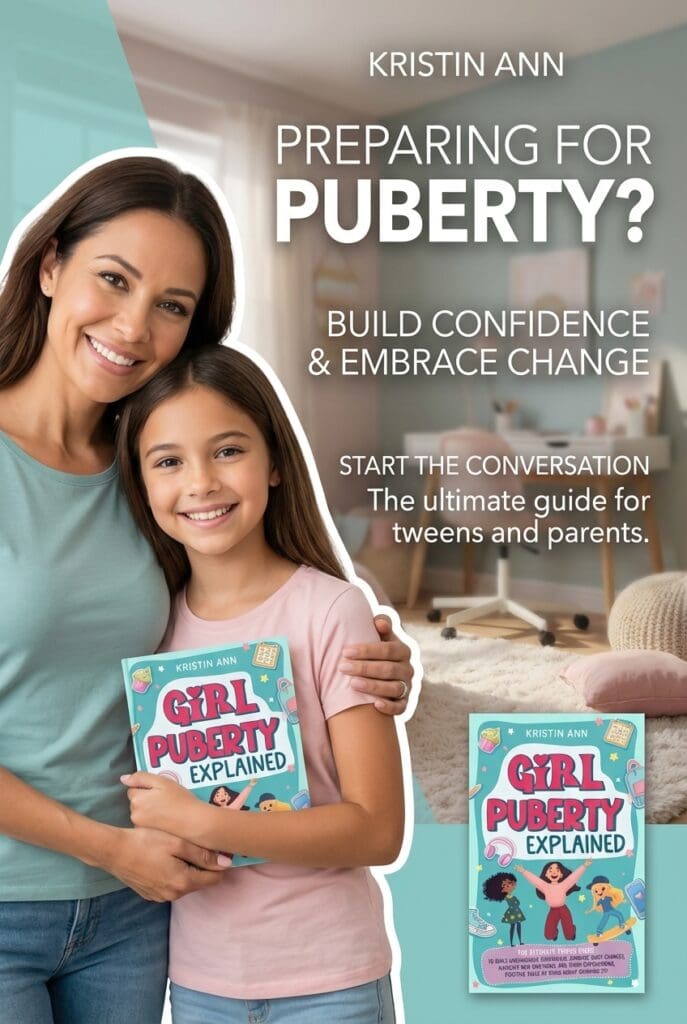
And if you’re looking for a trusted, age-appropriate resource that explains puberty clearly—without being cartoony or overwhelming. Many families keep Girl Puberty Explained on hand as a quiet backup when new questions pop up for a calm, practical guide trusted by thousands of parents, with a 4.8-star rating and over 260 reviews.
👉 You can learn more about the book here.

Books Mentioned & Other Recommendations
Girl Puberty Explained—The ultimate tween guide to build unshakeable confidence, embrace body changes, navigate new emotions, and spark empowering, positive talks at home about growing up!
Girl Body Confidence— Essential tools to grow up strong, build bonfidence, inspire easier conversations with loved ones, nurture a positive body image, empower resilience through buberty & beyond.
Can’t decide between the two? Get All About Growing Up for Girls 2 in 1 Collection which has both books in one! Practical puberty & confidence guides to manage emotions, build real friendships, love body changes & grow from awkward to awesome.